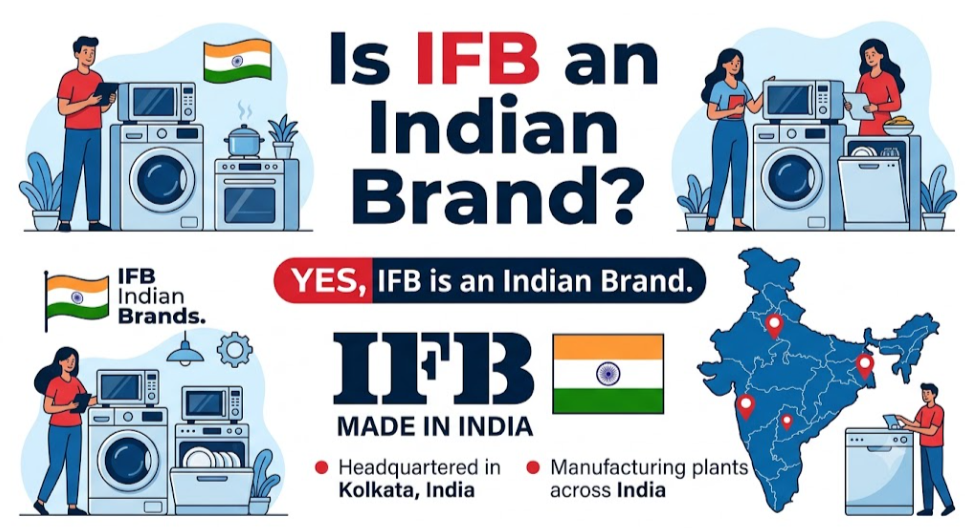
Yes — IFB Industries is an Indian company, founded in India and headquartered in the country, and remains Indian in ownership and control despite past technical collaborations with foreign firms. The promoter (Nag) family group holds a commanding 74.96% stake.
Overview
- IFB Home Appliances is an Indian home appliances company and a division of IFB Industries, listed on the NSE (IFBIND) and BSE (505726).
- Headquartered in Kolkata, India, with manufacturing at Kolkata and Verna, Goa, and a retail network of roughly 530 outlets called “IFB Point.”
- Its product range spans washing machines, refrigerators, air conditioners, microwave ovens, hobs, chimneys, dishwashers, and clothes dryers.
- IFB holds notably strong category positions: it’s the third-largest player in microwave ovens (18% market share), and dominates with 80% share in clothes dryers and 50% in dishwashers.
- The business has scaled significantly — net sales grew from about ₹2,657 crore in March 2019 to over ₹5,091 crore by March 2025, with the Home Appliances division driving roughly 80% of revenue.
Origin Story
- IFB was originally known as Indian Fine Blanks Limited, starting operations in India in 1974 in collaboration with Heinrich Schmid AG of Switzerland — initially producing fine-blanked components, tools, and related machine tools (straighteners, decoilers, strip loaders), with engineering divisions in Kolkata and Bangalore.
- The company was founded by Bijon Nag in Kolkata, West Bengal.
- In 1989, IFB entered an agreement with Bosch-Siemens Hausgeräte to produce fully-automatic washing machines and other domestic appliances, with the collaboration focused specifically on front-loading models, seen as superior for fabric care and water efficiency.
- IFB launched its first home appliance line in 1989 — front-loading, fully automatic washing machines aimed at urban Indian households — capitalizing on post-liberalization policy changes like reduced component tariffs. At the time, the Indian market was dominated by cheaper semi-automatic machines, leaving a premium niche for automatics in metros.
- Early marketing positioned IFB as a premium brand embodying German technological precision, reliability, and ease of use.
- The formal Home Appliances Division started in 1990–91, and the company rebranded to IFB Industries Limited in 1989, expanding into Bangalore as it grew from a fine-blanked-components maker into a consumer-durables powerhouse.
- A late-1990s Verna, Goa manufacturing facility was added, with later expansions for dishwashers — helping IFB scale and reduce import dependency. By the 2000s, IFB had become India’s top brand for front-loading washing machines.
FAQ
Is IFB fully Indian-owned, despite the foreign tech partnerships?
Yes — even with past technical collaborations with Swiss and German firms, ownership and control have remained Indian throughout.
What does “IFB” originally stand for?
Indian Fine Blanks (Limited) — its original name before the 1989 rebrand to IFB Industries Limited.
When did IFB enter home appliances (its now best-known business)?
Around 1989–1991, via a technical partnership with Bosch-Siemens, launching India’s first front-loading fully automatic washing machines.
Who are IFB’s main competitors today?
It competes with brands like LG Electronics and Samsung, particularly in the premium washing machine segment.
Is IFB still involved in engineering/industrial components, or just appliances now?
Both — IFB retains an engineering division (fine-blanked components, motors for white goods and automotive applications) alongside its larger, revenue-dominant Home Appliances division.
Want a deeper look at IFB’s current product strategy, its industrial/engineering business, or how it compares to LG/Samsung in India’s appliance market?