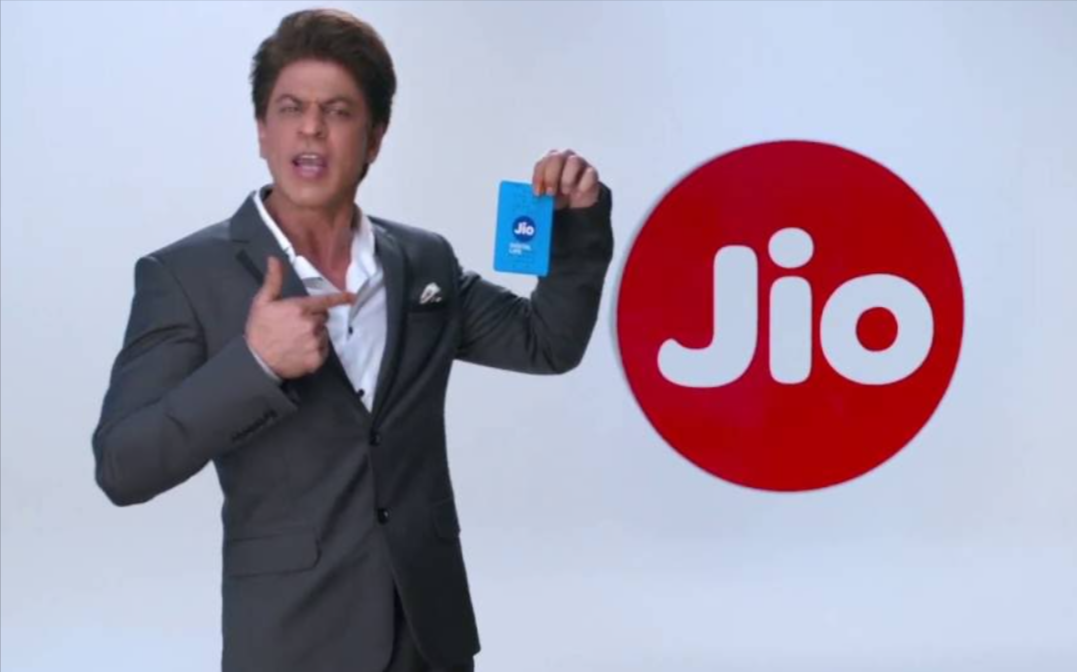
Jio’s core ambassador story centers on one name: Shah Rukh Khan, appointed in 2015/2016 to front the brand ahead of its commercial launch, giving Reliance Jio instant countrywide and global recognition as it prepared to roll out its first 4G plans (headlined by a 20GB daily data allowance and unlimited calling with no roaming or STD charges to worry about). The pairing worked on a few levels:
- Awareness and credibility: Khan’s stature gave a brand-new telecom entrant instant trust and media attention at a moment when 4G itself was still new to most Indian consumers.
- Brand identity: His commanding on-screen presence helped shape Jio’s self-image as modern, disruptive, and aspirational — mirroring the scale of Jio’s ambitions in the market.
- Emotional connect: Khan became closely tied to the launch moment itself, making him a symbolic figure of Jio’s breakthrough and, more broadly, of India’s digital leap forward. He has continued to be associated with the brand since.
Beyond this central pairing, Jio’s many sub-brands and campaigns have drawn on a wider bench of Bollywood and sports talent for specific initiatives rather than brand-wide roles:
- Deepika Padukone & Ranveer Singh — fronted Jio’s “Dhan Dhana Dhan” campaign.
- Abhishek Bachchan — featured in various Jio promotional campaigns.
- Rohit Sharma — brand ambassador specifically for JioCinema.
- Bhumi Pednekar — ambassador for the short film category at the Jio MAMI Film Festival.
- Pankaj Tripathi — brand ambassador for Jio-bp, the fuel-retail joint venture between Jio-bp and BP.
Portfolio — Complete Overview
Origins and launch
- Jio’s roots trace to the 2005 split between Mukesh and Anil Ambani, after which Reliance’s original telecom venture, Reliance Infocomm, went to Anil Ambani’s group.
- In June 2010, Reliance acquired Infotel Broadband Services Limited (IBSL) — the only bidder to win 4G spectrum across all 22 telecom circles in India — and rebranded it as Reliance Jio Infocomm Limited.
- Jio soft-launched internally in 2015 and commercially launched to the public on September 5, 2016, offering free voice calls and six months of free data — a move that triggered what’s been described as the world’s largest surge in data consumption almost overnight, and forced a wave of consolidation among incumbent telecom players.
Growth milestones
- 2017: Launch of the JioPhone, a low-cost 4G feature phone that accelerated the shift of millions of users from 2G to 4G.
- 2018: JioGigaFiber announced at Reliance’s AGM, laying the groundwork for what would become JioFiber, Jio’s home broadband service.
- 2020: Reliance created Jio Platforms as a dedicated entity and raised more than ₹1.5 lakh crore from global investors including Meta, Google, KKR, Silver Lake, Vista Equity Partners, and Saudi Arabia’s Public Investment Fund — a fundraising round that helped parent Reliance Industries become net debt-free.
- 2022: Jio launched True 5G services, backed by a $25 billion (₹2 lakh crore) investment commitment from Mukesh Ambani, rolling out across major cities and aiming for pan-India district coverage by December 2023.
- 2023: Launch of JioAirFiber, a Fixed Wireless Access (FWA) broadband service delivered over 5G — no fibre cable required, just a plug-in router — aimed at homes in smaller towns and semi-urban/rural areas. By September 2025 it had grown to nearly 9.5 million subscribers, making it the largest FWA service in the world.
- 2024: Reliance and The Walt Disney Company formed an $8.5 billion joint venture merging JioCinema with Disney+ Hotstar.
- 2025: The merged platform launched as JioHotstar on February 14, 2025, combining movies, live sports, originals, and international content — reportedly reaching 600 million users within its first three months.
Current portfolio
Jio’s ecosystem today spans mobile services, JioFiber and JioAirFiber (home broadband), JioHotstar (streaming), JioTV, JioSaavn (music), JioCloud, JioMeet, JioMart (e-commerce), and JioMoney/Jio Financial Services, alongside enterprise offerings in cloud infrastructure, data centres, and connectivity, plus growing investment in AI, edge computing, and satellite broadband.
Scale (as of FY26 disclosures)
- Roughly 524 million subscribers, making Jio India’s largest mobile operator by a wide margin.
- Average revenue per user (ARPU) around ₹214.
- Jio Platforms reported a 13% year-on-year rise in net profit to ₹7,935 crore and a 13% rise in revenue to ₹38,259 crore in Q4 FY26.
- An IPO for Jio has been publicly flagged by Mukesh Ambani, targeted for the first half of 2026, as Jio Platforms has become one of Reliance Industries’ most valuable businesses.
FAQ
Q: Who is Jio’s main brand ambassador?
A: Shah Rukh Khan, signed on ahead of Jio’s 2016 commercial launch and still closely associated with the brand.
Q: Does Jio have other celebrity ambassadors?
A: Yes — but mostly tied to specific sub-brands or campaigns rather than the core Jio brand: Rohit Sharma for JioCinema, Pankaj Tripathi for Jio-bp, Deepika Padukone and Ranveer Singh for the “Dhan Dhana Dhan” campaign, Abhishek Bachchan in various promotions, and Bhumi Pednekar for the Jio MAMI Film Festival’s short film category.
Q: When did Jio launch, and who founded it?
A: Jio commercially launched on September 5, 2016, under Mukesh Ambani’s Reliance Industries, built on the 2010 acquisition of Infotel Broadband Services Limited.
Q: What is Jio’s biggest recent product launch?
A: JioHotstar, launched February 14, 2025, merging JioCinema with Disney+ Hotstar following Reliance’s $8.5 billion joint venture with Disney.
Q: How big is Jio today?
A: Around 524 million subscribers as of FY26, making it India’s largest mobile network operator, with a rapidly expanding footprint in broadband (JioFiber/JioAirFiber), streaming (JioHotstar), and e-commerce (JioMart).
Q: Is Jio going public?
A: Mukesh Ambani has confirmed plans for a Jio IPO, targeted for the first half of 2026, though this remains subject to change as preparations continue.
Q: What was Jio’s original disruptive offer?
A: Free voice calls for life and six months of free data at commercial launch in 2016, undercutting incumbent operators and triggering a nationwide price war in Indian telecom.