Yes – Plum (branded as Plum Goodness) is a fully Indian brand — founded, headquartered, and built entirely in India.
Overview
Plum Goodness is a beauty and personal care brand, marketed as India’s first 100% vegan, cruelty-free, and non-toxic beauty brand. It offers skincare, haircare, body care, and makeup products, with over 500 SKUs, positioned around a “goodness inside” philosophy targeting India’s millennial and Gen Z consumers. The company behind Plum is Pureplay Skin Sciences (India) Private Limited, headquartered in Thane, Maharashtra, which also owns Phy, a men’s grooming brand, and BodyLovin’, a youth-focused sub-brand.
Origin
Plum was founded by Shankar Prasad, a chemical engineering graduate from IIT Bombay who spent eight years at Hindustan Unilever, followed by an MBA from ISB Hyderabad and stints at McKinsey and Everstone Capital (where he worked with Faces Cosmetics).
The idea crystallized in 2013 after Shankar was disturbed by a scene in the film Ship of Theseus showing mascara being tested on rabbits. Searching for cruelty-free beauty brands, he noticed that many global brands avoiding animal testing abroad faced no such regulatory obligation in India — a gap he wanted to fill. He was also inspired by the “1% for the Planet” model pioneered by Patagonia’s founder. Pureplay Skin Sciences was incorporated on October 8, 2013, and Plum officially launched in July 2014 as one of India’s first fully vegan beauty brands.
Growth
- Plum was bootstrapped for its first five years, relying on capital-efficient growth before raising outside funding.
- It crossed an ₹100 crore annual revenue run-rate by 2019.
- It has since raised a total of $51.7 million across three funding rounds, including a Series B in 2021.
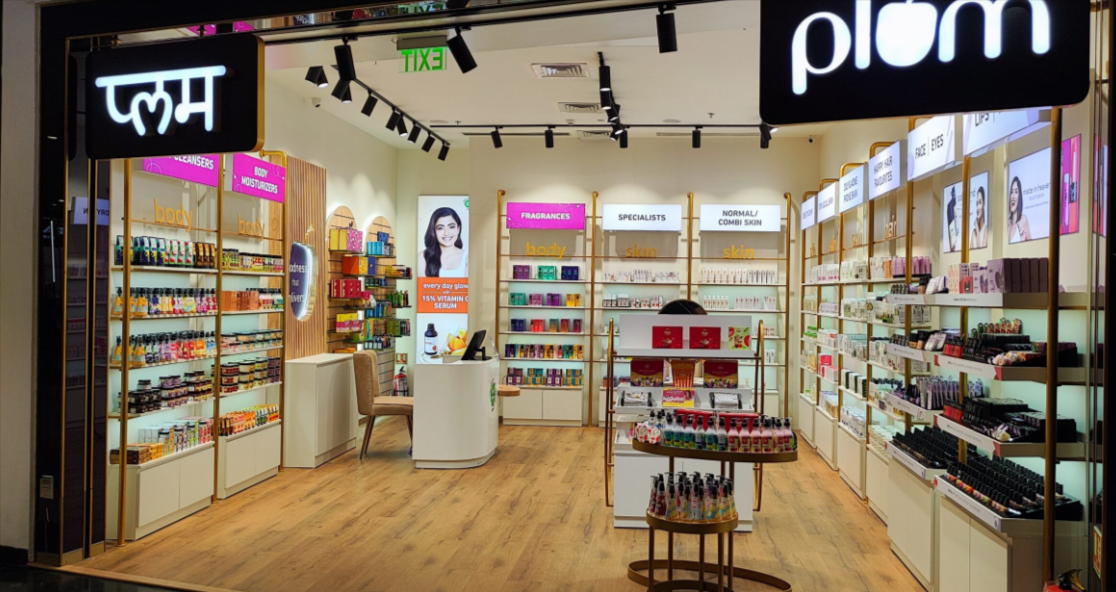
- The brand expanded from purely online into offline retail starting in 2018, and now reaches over 300 towns and cities in India through 1,300+ assisted retail outlets and 13,000+ unassisted outlets — with total physical touchpoints now exceeding 1,500.
- It has also expanded internationally, with a presence in 15 countries, including the US, Middle East, and South Asia.
- Financially, Plum entered its 10th year (FY24) with 71% revenue growth to ₹322 crore, alongside a loss of ₹52.9 crore — but achieved a turnaround in FY25, posting a ₹25 crore profit.
- Recent growth has moderated somewhat, with reported revenue growth cooling to around 22% in the most recent period, as the brand focuses on sustainable, profitable growth rather than pure scale.
- Ownership remains founder-heavy: founders hold roughly 53% of the company, with funds holding the rest.
Future Plans
- Plum is widely seen as a strong candidate for a liquidity event within the next 2–3 years — either an IPO or a strategic acquisition — following the path of peers like Nykaa and Honasa (Mamaearth) into Indian public markets.
- To support a successful public listing, the company is understood to need consistent, sustained profitability and to cross roughly the ₹500 crore revenue threshold, given how strictly Indian public markets have scrutinized unprofitable D2C consumer brands post-listing.
- Continued category expansion beyond core skincare into makeup, men’s grooming (via Phy), and youth-focused ranges (BodyLovin’).
- Deepening its offline retail footprint further, building on its existing 1,500+ physical touchpoints.
- Sustained emphasis on customer trust and retention — the brand reports around a 40% repeat purchase rate — as a foundation for further scaling.
FAQ
Is Plum an Indian-owned company?
Yes — fully Indian-founded, Indian-headquartered (Thane, Maharashtra), and majority Indian-owned by its founders, alongside domestic and international investors.
Who founded Plum?
Shankar Prasad, an IIT Bombay chemical engineering graduate and former Hindustan Unilever and McKinsey professional.
When was Plum launched?
The parent company, Pureplay Skin Sciences, was incorporated in 2013; the Plum brand launched in July 2014.
Is Plum really 100% vegan?
Yes — it markets itself as India’s first fully vegan and cruelty-free beauty brand, PETA-approved, with non-toxic formulations.
Is Plum profitable?
It turned profitable in FY25 (₹25 crore profit) after years of loss-making growth, though recent revenue growth has slowed compared to its earlier hyper-growth years.
Does Plum sell outside India?
Yes — it has expanded into around 15 countries, including the US, Middle East, and South Asia, alongside its dominant domestic Indian market presence.