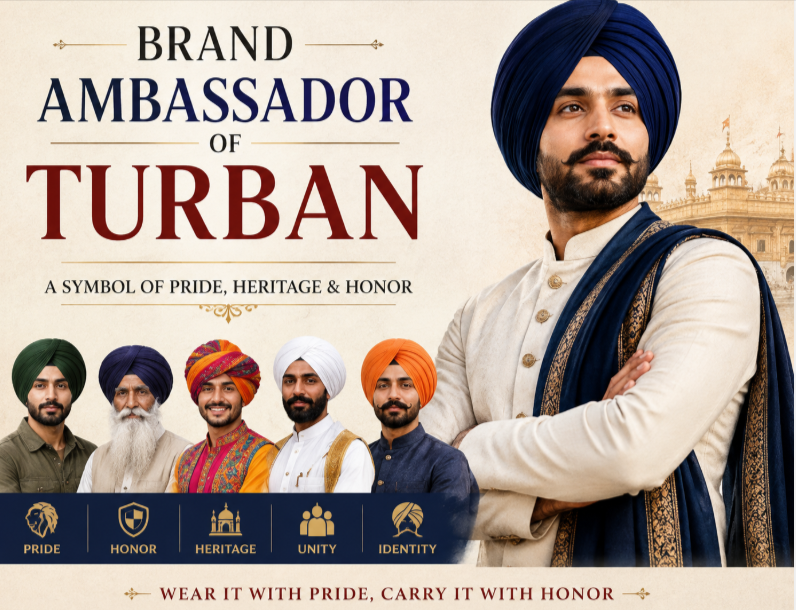
Brand Ambassador of “Turban” — Overview
Unlike the commercial brands covered earlier, the turban isn’t a product with a single formal “brand ambassador” appointed by a company — it’s a religious and cultural article of faith, primarily central to Sikhism. That said, several individuals have been informally described in media as ambassadors of the turban’s image and cultural presence — plus there’s been at least one notable controversy around the specific title.
Within Sikhism itself, every Sikh wearing a turban is considered a walking ambassador of the faith — instantly recognizable and accountable for their actions, and by wearing the turban, Sikhs serve as ambassadors of their faith, outwardly committing to the path laid down by the Sikh Gurus. So in the deepest sense, the concept of “turban ambassador” is understood as a lived, personal commitment rather than a commercial title.
Notable Cultural Ambassadors of the Turban
Vikram Singh Chatwal — Most frequently cited as the closest thing to a literal “global brand ambassador” of the turban.
- According to Delhi-based fashion designer J.J. Vallaya, “He’s the closest the turban has to a global brand ambassador… He’s done movies with the turban on and off, he’s modelled with it, and he’s made it a point to flaunt it.”
- Chatwal himself credited India’s Oxbridge-educated former PM Manmohan Singh with reshaping the turban’s global image, saying his visibility as leader of the world’s largest democracy helped make Sikhs more mainstream internationally.
- His high-profile personal life — including his widely publicized “Big Fat Sikh Wedding” — placed him at the center of what was described as the subcontinent’s foray into “Global Cool.”
Sidhu Moose Wala — Posthumously and informally associated with the title.
- The Punjabi singer was referred to with the “Brand Ambassador of Turban” title in media coverage, a designation that reportedly sparked some controversy and drew reaction from segments of the Sikh community.
Bally Singh — Dubai-based entrepreneur, notable for representing turbaned identity in luxury fashion.
- Appeared as a brand ambassador for Italian luxury menswear house Ermenegildo Zegna, and framed his presence explicitly in terms of representation: “not just as me, Bally Singh, but as a Sikh, for them to use me shows the world how diverse and unique the Zegna brand is.”
Harbidner Singh — Rising figure in fashion/entertainment.
- Described as the first mature Sikh model to walk at New York Fashion Week, and known as a dialogue writer for the international film “Love in Vietnam.”
- He founded Kahani Road Productions, developing narrative projects designed to challenge cultural stereotypes and celebrate authentic South Asian and Sikh heritage.
Sonny Caberwal — Early pioneer in mainstream fashion.
- Became one of the first turbaned Sikh models after being cast when fashion label Kenneth Cole searched for — and initially couldn’t find — a turbaned Sikh model for its 25th-anniversary ad campaign.
Turban’s Cultural Significance — Beyond Commercial Ambassadorship
The turban’s meaning runs far deeper than fashion or brand marketing, and this context is essential to understanding why the “brand ambassador” framing is sometimes contested:
- Article of faith, not accessory: The Dastar (Sikh turban) is an article of faith that the founders of Sikhism made mandatory — not merely cultural paraphernalia. When tied, it ceases to be a piece of cloth and becomes one with the Sikh’s very identity.
- Historical continuity: The turban has been central to Sikh tradition since Guru Nanak Dev Ji, with historical accounts confirming all Sikh Gurus wore turbans, a practice followers have continued since the faith’s founding. It is described as the same turban that stood against caste oppression in India, tyranny in WWI, and the Nazi empire in WWII.
- A declaration, not decoration: Tying the turban each day represents a real, living commitment — a declaration that the wearer will stand firm against tyranny and protect the downtrodden.
- Personal spiritual discipline: The turban reflects a disciplined mind and commitment to a spiritual path, tied to the practice of keeping kesh (uncut hair) as a natural way of living that acknowledges God’s creation.
The commercial-appropriation controversy: This tension between sacred meaning and commercial/fashion use came to a head publicly:
- Gucci was accused of culturally appropriating the Sikh turban after sending predominantly white, non-Sikh models down the runway wearing turbans at Milan Fashion Week in 2018.
- The New York-based Sikh Coalition responded: “The Sikh turban is a sacred article of faith, @gucci, not a mere fashion accessory… We are available for further education and consultation if you are looking for observant Sikh models.”
- India-based restaurateur Harjinder Singh Kukreja added: “Your models have used Turbans as ‘hats’ whereas practising Sikhs tie them neatly fold-by-fold. Using fake Sikhs/Turbans is worse than selling fake Gucci products.”
- The controversy resurfaced when Gucci began selling the turbans as a nearly $800 product through Nordstrom, prompting renewed criticism that a sacred article of faith was being monetized by people who wouldn’t understand its religious significance.
This context explains why calling any individual the literal “brand ambassador of turban” is sensitive — the turban functions as a marker of collective religious identity and historical struggle, not a product with a marketing spokesperson, even when individual Sikhs are informally described that way in pop culture.
FAQ
Q: Is there an official “brand ambassador of the turban”?
A: No formal, single appointed role exists — this differs fundamentally from commercial brand ambassadorships. Media and fashion commentators have informally applied the term to a few high-profile turbaned individuals, most notably Vikram Singh Chatwal.
Q: Who is most commonly called the turban’s “global brand ambassador”?
A: Vikram Singh Chatwal, per fashion designer J.J. Vallaya, largely due to his consistent, visible presence wearing the turban across films, modeling, and high-profile media coverage.
Q: Why did Sidhu Moose Wala being called “brand ambassador of turban” cause controversy?
A: The specific reporting indicates it “ignited a row” and drew reaction from sections of the Sikh community, though the underlying reasons for the controversy aren’t detailed in the available sources.
Q: Is it appropriate for a non-Sikh brand or model to use the turban commercially?
A: This has been a significant point of controversy — most visibly with Gucci in 2018, which was accused of cultural appropriation for using non-Sikh models in turbans on the runway and later selling turbans as luxury fashion items, drawing strong pushback from Sikh advocacy organizations.
Q: What does the turban actually mean in Sikhism?
A: It’s a mandatory article of faith (not a cultural choice), covering the uncut hair (kesh) that Sikhs maintain out of respect for God’s creation — representing spiritual discipline, identity, and an outward commitment to Sikh values, including standing against oppression.
Q: Are there Sikh models/figures intentionally representing the turban in mainstream fashion today?
A: Yes — individuals like Bally Singh (Zegna), Harbidner Singh (New York Fashion Week), and earlier Sonny Caberwal (Kenneth Cole) have taken on visible roles in fashion specifically as practicing, turbaned Sikhs, often framing their presence as authentic representation rather than mere modeling work.