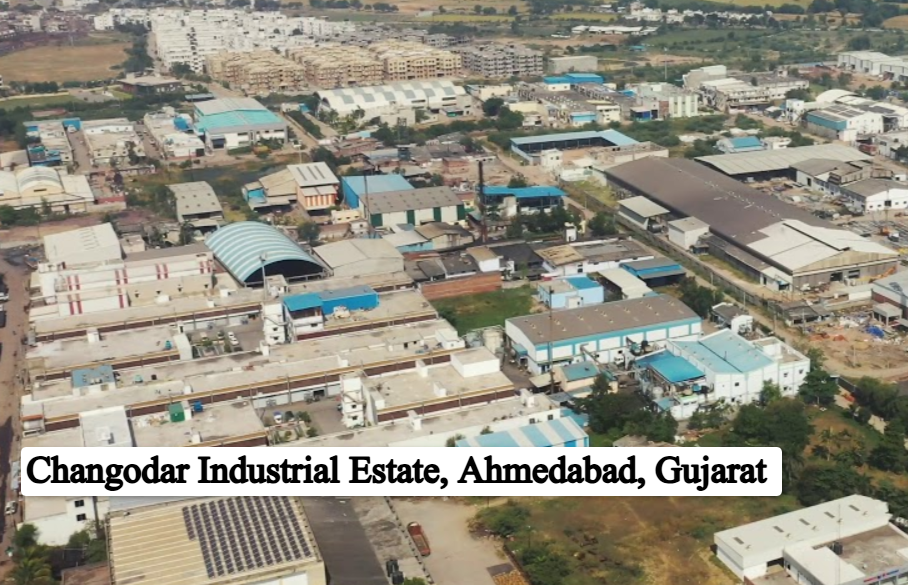
Changodar Industrial Estate is one of Ahmedabad’s most prominent industrial zones, located along the Sarkhej-Bavla Highway on the southwestern edge of the city. Home to a wide mix of SMEs and larger manufacturing businesses, the estate has grown into a genuine industrial hub over the past two decades, benefiting from its strategic position along Gujarat’s key transport corridors and its inclusion within the broader ambit of the Delhi-Mumbai Industrial Corridor (DMIC).
Beyond pure manufacturing, Changodar has developed into a mixed residential-industrial locality, with schools, hospitals, and everyday retail infrastructure growing up around its industrial core to serve the area’s expanding working population — making it as much a functioning township as a traditional industrial estate.
Key Points Table
| Aspect | Details |
|---|---|
| Location | Sarkhej-Bavla Highway, Changodar, Ahmedabad, Gujarat – 382210/382213 |
| Type | Industrial estate — manufacturing, pharma, plastics, warehousing, logistics, engineering |
| Key Highway | Sarkhej-Bavla Highway, with access to NH-8 |
| Distance from Ahmedabad City Centre/Ahmedabad One Mall | Approx. 14 km |
| Distance from Airport | Reasonably accessible from Sardar Vallabhbhai Patel International Airport |
| Notable Sub-Estates | Akshar Industrial Park, Ashvamegh Industrial Estate, Panchratna Estate, and other smaller industrial parks within the Changodar belt |
| Typical Plot Sizes | Ranges from a few thousand sq. yards to very large plots of 100,000+ sq. metres for large-scale industrial use |
| Nearby Educational/Healthcare | Zydus School for Excellence; Krishna Shalby Hospital |
| Strategic Positioning | Falls within the Delhi-Mumbai Industrial Corridor (DMIC) zone of influence |
Location and Connectivity
Changodar’s location along one of Ahmedabad’s key highway corridors gives it strong logistics and transport advantages.
- Highway access: The estate sits directly along the Sarkhej-Bavla Highway, with good onward connectivity to NH-8, one of India’s major national highways linking Gujarat to Rajasthan, Delhi, and Mumbai.
- Airport: The estate provides reasonably good access to Sardar Vallabhbhai Patel International Airport, useful for businesses with air-cargo or executive travel needs.
- City centre access: Changodar is roughly 14 km from central Ahmedabad landmarks like Ahmedabad One Mall, keeping it within a practical commuting distance of the city.
- Industrial corridor positioning: Changodar’s location places it within the influence zone of the Delhi-Mumbai Industrial Corridor (DMIC), a flagship infrastructure initiative expected to bring significant long-term development and investment to the region.
- Multiple industrial sub-parks: The broader Changodar belt includes various named industrial estates and parks (Akshar Industrial Park, Ashvamegh Industrial Estate, Panchratna Estate, and others), each contributing to a dense, interconnected industrial cluster.
Business and Commercial Importance
Changodar has emerged as one of Ahmedabad’s most active industrial hubs, attracting both established manufacturers and companies aligned with national industrial initiatives.
- The estate hosts a diverse business mix — companies engaged in stationery manufacturing, flexi-printing, healthcare products, pharmaceuticals, plastics, and general engineering are all represented in the area.
- Several industrial parks in Changodar, such as Akshar Industrial Park, are explicitly positioned to support India’s “Make in India” initiative, aiming to boost domestic manufacturing capacity in Gujarat.
- Large-format industrial plots (some as large as 100,000 sq. metres) available in the area make Changodar suitable for large-scale production units, auto manufacturing, FMCG plants, and export-oriented industries, not just small workshops.
- Its proximity to multinational companies and other established industrial hubs in the vicinity adds to the area’s investment appeal, with real estate listings citing high return-on-investment potential driven by rising industrial demand.
- The presence of NA-approved (non-agricultural) industrial land with access to utilities makes the area attractive for businesses seeking hassle-free land acquisition for expansion.
Nearby Infrastructure and Facilities
- Zydus School for Excellence — a well-regarded educational institution serving families in the Changodar area.
- Krishna Shalby Hospital — a healthcare facility providing medical services to the local industrial and residential population.
- Restaurants, banks, and medical facilities — basic daily-necessity infrastructure has developed alongside the estate’s industrial growth.
- Residential complexes — a growing number of housing developments in and around Changodar cater to the area’s expanding workforce.
- Sub-industrial parks and estates — Akshar Industrial Park, Ashvamegh Industrial Estate, and Panchratna Estate, among others, provide additional plotted industrial infrastructure within the broader Changodar belt.
Advantages of the Location
- Strong highway connectivity, with direct access to the Sarkhej-Bavla Highway and onward links to NH-8, supporting efficient logistics and freight movement.
- Strategic position within the Delhi-Mumbai Industrial Corridor, offering long-term growth potential as DMIC-linked infrastructure develops further.
- Large land parcels available, making it suitable for both small-scale units and large industrial or export-oriented setups.
- Reasonable airport access via Sardar Vallabhbhai Patel International Airport, useful for businesses with air-cargo or travel needs.
- Developing social infrastructure, with schools, hospitals, and residential complexes emerging to support a growing working population.
- Business-friendly environment, reflected in NA-approved land titles and a steady stream of industrial investment in the area.
Challenges or Limitations
- Distance from Ahmedabad city centre: at around 14 km, commuting from central Ahmedabad can take significant time, particularly during peak traffic hours.
- Uneven development across sub-estates: since Changodar comprises multiple distinct industrial parks and estates, infrastructure quality and amenities can vary considerably from one sub-estate to another.
- Reliance on road transport: as with most Indian industrial estates without direct rail-freight access, businesses here depend heavily on road logistics, which can be affected by highway traffic and maintenance issues.
- Rapid, sometimes uneven growth: the area’s fast industrial and residential expansion can outpace civic infrastructure development in specific pockets, a common challenge in fast-growing peripheral industrial zones.
- Variable plot and building quality: since land and sheds are sold by multiple developers and agents across the belt, due diligence on titles, utilities, and construction quality is important before purchase.
FAQ
Q: Where exactly is Changodar Industrial Estate located?
It’s located along the Sarkhej-Bavla Highway in Changodar, on the southwestern outskirts of Ahmedabad, Gujarat – pin codes around 382210/382213.
Q: How far is it from Ahmedabad’s city centre?
Roughly 14 km from central landmarks like Ahmedabad One Mall.
Q: What kind of industries operate in Changodar?
A broad mix, including stationery and printing, pharmaceuticals, plastics, healthcare products, engineering, and larger-scale manufacturing such as auto components and FMCG production.
Q: Is Changodar linked to any major national industrial initiatives?
Yes — several industrial parks in the area, such as Akshar Industrial Park, are explicitly aligned with India’s “Make in India” initiative, and the broader Changodar belt falls within the Delhi-Mumbai Industrial Corridor’s zone of influence.
Q: What social infrastructure is available nearby?
Educational institutions like Zydus School for Excellence, healthcare facilities such as Krishna Shalby Hospital, and a growing base of restaurants, banks, and residential complexes.
Q: Is Changodar suitable for large-scale manufacturing?
Yes — the area offers large industrial plots (some over 100,000 sq. metres), making it well suited for large-scale production units, warehousing, and export-oriented businesses, in addition to smaller SME operations.