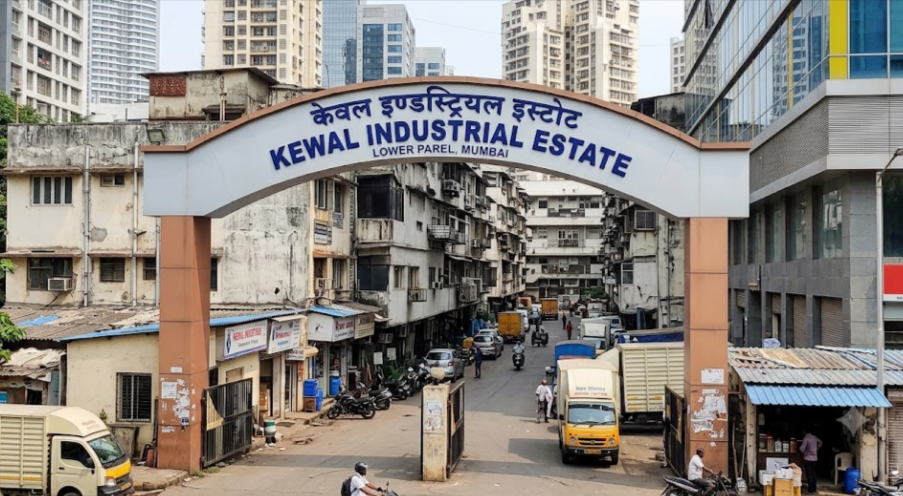
Kewal Industrial Estate is an established commercial complex on Senapati Bapat Marg in Lower Parel, in an area that was once dominated by Mumbai’s textile mills and has, over the past two decades, become one of the city’s most sought-after business districts. Like many of the older “industrial estate” buildings in this belt, Kewal has moved away from manufacturing toward office and trading use — its tenants today include textile and garment exporters, trading firms, and a growing number of service-sector and professional businesses. Its draw is largely its location: a recognized Lower Parel address at a price point generally lower than the newer Grade-A towers rising around it.
Key Points
- Located on Senapati Bapat Marg, Lower Parel West, Mumbai – PIN 400013, under the Delisle Road post office jurisdiction.
- A long-standing multi-storey commercial complex that has shifted from its original industrial character toward office, trading, and textile-export use.
- Sits in the heart of Mumbai’s former mill-land belt, now redeveloped into one of the city’s premier business districts.
- Well served by rail (Lower Parel, Parel, and Mahalaxmi stations all nearby), Mumbai Metro Line 3 (Aqua Line), and major arterial roads.
- Functions today as a comparatively affordable commercial address within an otherwise expensive corridor, popular with mid-sized firms and exporters.
Infrastructure and Industrial Facilities
- Building format: A multi-storey complex offering commercial units from roughly 500 sq ft up to about 3,000 sq ft, suited to both small businesses and mid-sized companies.
- Amenities: Reserved and common car parking, round-the-clock security and CCTV coverage, power backup, water storage, intercom, elevators, and fire-fighting systems are standard across the building.
- Management: The complex operates under a cooperative society structure that handles security, maintenance, and coordination among tenants — a setup credited with keeping the aging building at reasonable operating standards.
- Known constraints: Visitor parking is limited, and outside vehicles (including couriers) face restricted entry — a recurring point in tenant feedback.
- On-site support: An employee canteen serves the building’s workforce.
Connectivity and Transportation
- Roads: Senapati Bapat Marg connects directly to Dr. Baba Saheb Ambedkar Marg and N.M. Joshi Marg, with onward links to Worli, Prabhadevi, Dadar, and South Mumbai.
- Rail: Lower Parel station (Western Line) is roughly 500–600 metres away; Parel (Central Line) and Mahalaxmi (Western Line) stations are also within easy reach, giving the estate access to multiple rail lines.
- Metro: Mumbai Metro Line 3 (Aqua Line, Colaba–Bandra–SEEPZ) now serves the area, with Acharya Atre Chowk, Worli, and Siddhivinayak stations all nearby.
- Other infrastructure: The Bandra–Worli Sea Link and the Mumbai Coastal Road provide further direct routes to the western suburbs and South Mumbai respectively.
- Airport: Chhatrapati Shivaji Maharaj International Airport is about 15–18 km away, roughly a 30–45 minute drive depending on traffic.
Real Estate and Investment Trends
- Commercial real estate in the immediate area has generally traded in the range of ₹30,000–₹40,000 per sq ft, with premium new-build towers commanding more.
- Monthly rentals across the wider Lower Parel–Parel belt vary widely, from roughly ₹27,000 for compact units up to several lakhs for larger Grade-A spaces.
- The estate itself has continued to see transaction activity, with public property records showing multiple registered sales in recent periods.
- Demand in the surrounding market has been pulled upward by large nearby developments — corporate towers, premium residential projects, and retail-led complexes — which has, in turn, lifted interest in older, comparatively affordable buildings like Kewal.
Workforce and Economic Role
- The estate houses a range of businesses spanning manufacturing/trading remnants, textile exports, finance, media, and professional services, employing a workforce drawn from across Mumbai.
- Its central location and strong transit access make it a practical commuting destination for staff from South Mumbai as well as the central and western suburbs.
- A wider support economy has grown around the building — canteens, tea stalls, courier and printing services, and local transport operators — typical of Lower Parel’s dense daytime office population.
- Nearby retail and dining destinations, including major mall developments a short walk away, add further convenience for the estate’s workforce.
Future Growth Potential
- Continued build-out of Metro Line 3, further Coastal Road extensions, and ongoing road upgrades along Senapati Bapat Marg are likely to support rising values across older buildings in the corridor.
- As newer Grade-A towers push rents higher across Lower Parel and the Bandra-Kurla Complex, more moderately priced, well-located buildings such as Kewal are positioned to remain attractive to mid-sized firms and exporters that want a recognized address without premium-tower costs.
- Lower Parel’s broader trajectory — from mill land to a mixed office, retail, residential, and leisure district — suggests continued, if incremental, appreciation for established complexes in the area.
FAQ
Q1. Where exactly is Kewal Industrial Estate located?
On Senapati Bapat Marg in Lower Parel West, Mumbai – PIN 400013, near Phoenix Mills and the Shah & Nahar Estate.
Q2. Is it still used for manufacturing?
Largely no — like many similarly named buildings in this belt, it now functions mainly as commercial office and trading space, though some manufacturing/trading tenants remain.
Q3. What’s the nearest railway station?
Lower Parel station on the Western Line, about 500–600 metres away; Parel and Mahalaxmi stations are also close by.
Q4. Is it connected to the Mumbai Metro?
Yes — Metro Line 3 (Aqua Line) serves the area, with Acharya Atre Chowk, Worli, and Siddhivinayak stations nearby.
Q5. What size office units are available?
Typically from about 500 sq ft up to 3,000 sq ft, suiting both small and mid-sized businesses.
Q6. How far is the airport?
Roughly 15–18 km from CSMIA, about a 30–45 minute drive depending on traffic.
Q7. Who manages the building?
A cooperative society handles security, common-area maintenance, and tenant coordination.
Q8. Is this a good investment or lease option compared to newer Lower Parel towers?
It tends to be more affordable than newer Grade-A developments in the same corridor, which is part of its appeal to mid-sized firms — though as with any older building, it’s worth weighing against the amenities and image of premium new-build alternatives nearby.