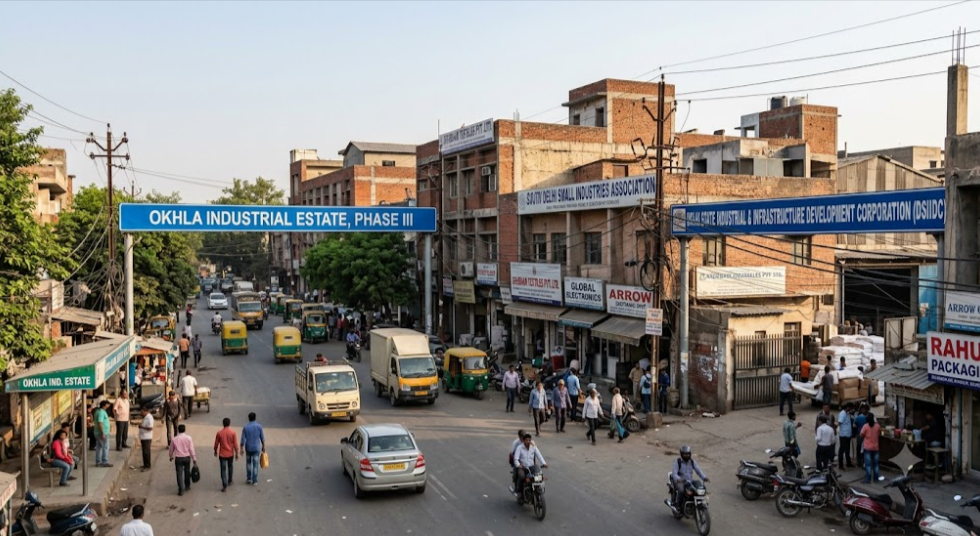
Okhla Industrial Estate is one of Delhi’s oldest and most significant industrial hubs, located in South (East) Delhi near the Yamuna River. Established by the National Small Industries Corporation (NSIC), it was one of 12 such estates developed across India to promote small-scale industry — construction began in 1952 and the estate was formally inaugurated in 1958. Over the decades it has grown into a sprawling industrial and commercial zone, today divided into three phases, each with a distinct character: Phase I is known for small and medium enterprises, Phase II serves as the core manufacturing and warehousing zone, and Phase III — laid out by British architect Walter George, known for his work on Parliament House and the North and South Blocks — functions as a more premium corporate district.
The estate takes its name from the nearby Okhla area (itself lending its name to NOIDA — New Okhla Industrial Development Authority) and has become synonymous with Delhi’s small-scale industrial growth, hosting everything from garment exporters to pharmaceutical manufacturers and modern IT/start-up offices.
Key Points
| Aspect | Details |
|---|---|
| Location | Okhla, South (East) Delhi – Pin code 110020 |
| Established | Construction began 1952; inaugurated 1958 by NSIC |
| Structure | Divided into Phase I (SMEs), Phase II (manufacturing/warehousing), Phase III (premium corporate district) |
| Phase III Architect | Walter George (also known for Parliament House and North/South Blocks); spans 110 acres |
| Key Roads | Mathura Road, Maa Anandmayi Marg, NH24/NH2 corridor |
| Metro Access | Okhla Vihar, Govind Puri, Jasola Vihar, and Nehru Place stations (Magenta and Violet Lines) |
| Distance from IGI Airport | Approx. 18–22 km via Ring Road (45–60 min) |
| Key Industries | Garment and leather exports, pharmaceuticals, plastics/packaging, printing, machinery, call centres, IT/start-up offices |
| Nearby Business Districts | Nehru Place, Lajpat Nagar, Connaught Place |
Location and Connectivity
Okhla Industrial Estate’s location in South Delhi gives it some of the strongest logistics and transit connectivity of any industrial zone in the NCR.
- Metro: The estate is served by multiple Delhi Metro stations across its phases — Okhla Vihar (nearest, Magenta Line), Govind Puri and Harkesh Nagar Okhla (Violet Line), and Jasola Vihar (Magenta Line) — giving different parts of the estate direct rail-based access.
- Roads: Major arteries include Mathura Road and the NH24/NH2 corridor, both linking Okhla to central Delhi, Noida, and Faridabad; within Phase II, Maa Anandmayi Marg is the key wide road built to support heavy vehicle and truck movement for manufacturing and warehousing operations.
- Railway: Okhla railway station is located within the neighbourhood, adding suburban rail access alongside metro connectivity.
- Airport: Indira Gandhi International Airport is roughly 18–22 km away, about a 45–60 minute drive via Ring Road, making it workable for businesses with air-cargo or frequent-travel needs.
- Inter-state links: The estate’s road network gives it easy access to neighbouring Uttar Pradesh (Noida) and Haryana (Faridabad/Gurugram), supporting inter-state trade and logistics.
Business and Commercial Importance
Okhla Industrial Estate has been a cornerstone of Delhi’s industrial economy for over six decades, and its business mix has diversified considerably since its founding.
- Historically, the estate has been a major revenue base for ready-made garment and leather garment exporters, alongside pharmaceutical manufacturing units, plastics and packaging industries, printing presses, and machinery manufacturers.
- More recently, it has attracted call centres, MNC offices, banks, and IT/start-up companies, reflecting a shift toward service-sector and knowledge-based businesses alongside its traditional manufacturing base.
- Its structured three-phase layout allows businesses to choose the environment that fits their needs — small and medium enterprises in Phase I, large-scale manufacturing and warehousing in Phase II (built for high-capacity goods movement and container traffic), and premium corporate offices in Phase III.
- Proximity to major business districts like Nehru Place, Lajpat Nagar, and Connaught Place gives Okhla-based businesses strong access to Delhi’s wider commercial ecosystem, clients, and service providers.
Nearby Infrastructure and Facilities
- Nehru Place — one of Delhi’s major commercial and IT hardware markets, a short distance from Okhla.
- Lotus Temple — a globally recognised architectural landmark located in the Okhla neighbourhood.
- IIIT Delhi and Govind Ballabh Pant Engineering College — nearby technical institutions that provide a steady talent pool for the estate’s IT, manufacturing, and service industries.
- NSIC (National Small Industries Corporation) — headquartered in the area, reflecting the estate’s institutional roots in small-industry promotion.
- Okhla Bird Sanctuary — a notable natural landmark near the industrial belt.
- Hospitals and clinics — several healthcare facilities are located near the estate, supporting the large industrial workforce.
- Colleges and technical institutes — multiple educational institutions in the vicinity contribute to a steady supply of skilled and semi-skilled labour.
Advantages of the Location
- Long-established industrial ecosystem, with well-developed roads, utilities, and infrastructure built up over more than six decades of continuous industrial activity.
- Excellent multi-modal connectivity, combining Delhi Metro access (Magenta and Violet Lines), major road corridors (Mathura Road, NH24/NH2), and proximity to the airport.
- Structured phase system, letting businesses choose the environment suited to their scale — from small workshops to large warehousing to premium corporate offices.
- Skilled and semi-skilled labour access, supported by nearby technical institutes and colleges.
- Proximity to major Delhi business districts (Nehru Place, Lajpat Nagar, Connaught Place), improving access to clients, services, and talent.
- Diverse business ecosystem, reducing dependence on any single industry and giving the estate resilience across economic cycles.
Challenges or Limitations
- Traffic congestion: roads within and around Okhla see heavy congestion during peak hours, affecting both commuting and the movement of goods.
- Poor internal road maintenance: several internal lanes, especially in Phase II, are reported to be damaged or uneven, with conditions worsening during the monsoon.
- Pollution and noise: as a dense, long-established industrial zone, Okhla faces air and noise pollution challenges typical of older industrial estates in Delhi.
- Parking stress: parking is a frequent issue in the estate’s market and mixed-use stretches, particularly in commercial-facing pockets.
- Ageing infrastructure in older sections: parts of Phase I and Phase II, being among the oldest sections, may require upgrades to match the standards of newer industrial parks in the NCR.
FAQ
Q: When was Okhla Industrial Estate established?
Construction began in 1952, and the estate was formally inaugurated in 1958 by the National Small Industries Corporation (NSIC), as one of 12 such estates built across India to promote small-scale industry.
Q: How many phases does Okhla Industrial Estate have, and how do they differ?
Three phases: Phase I is known for small and medium enterprises, Phase II is the core manufacturing and warehousing zone, and Phase III (spread over 110 acres, designed by architect Walter George) functions as a premium corporate district.
Q: What metro stations serve Okhla Industrial Estate?
Okhla Vihar (Magenta Line) is nearest to the industrial estate; Govind Puri and Harkesh Nagar Okhla (Violet Line) and Jasola Vihar (Magenta Line) also serve different parts of the area.
Q: What industries dominate the estate?
Historically garment and leather exports, pharmaceuticals, plastics/packaging, printing, and machinery manufacturing; more recently, call centres, MNC offices, banks, and IT/start-up companies have added a service-sector dimension.
Q: How far is it from Indira Gandhi International Airport?
Roughly 18–22 km, about a 45–60 minute drive via Ring Road.
Q: What are the biggest challenges of operating in Okhla Industrial Estate?
Traffic congestion, pollution, parking stress, and poor maintenance of some internal roads (particularly in older phases) are commonly cited drawbacks, despite the area’s strong overall connectivity.